
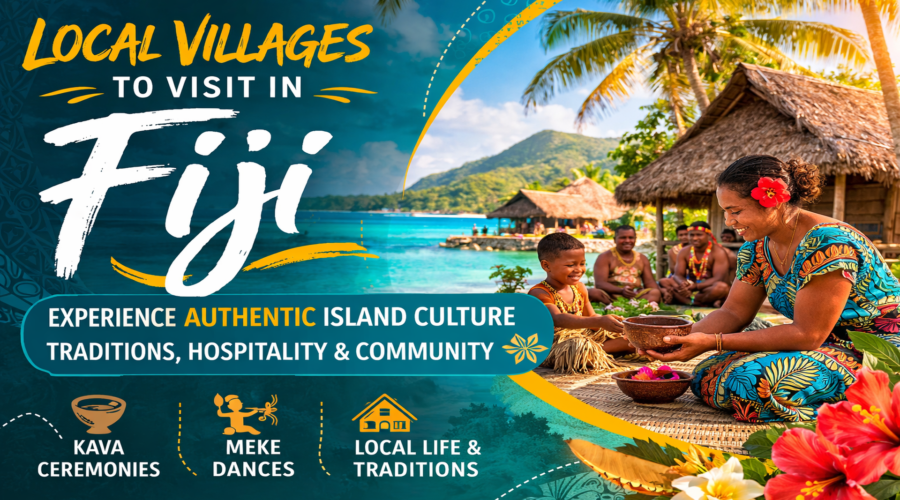
What Makes Local Villages to Visit in Fiji So Special?
Let’s be honest. Most people fly to Fiji for the postcard stuff.
The clear water. The fancy resorts. Nothing wrong with wanting a sunset cocktail by the water. That Fiji exists, and it’s gorgeous.
But there’s another Fiji most tourists never see.
It’s in the villages in Fiji along the coast. The ones tucked between the hills. Small places where life moves slowly, and tourists rarely show up. Here, nobody cares about Instagram photos. They care about family, church, and getting dinner on the table.
Local villages to visit in Fiji give you something no resort can. You get to sit with regular people going about their regular days. And somewhere in there, you realize they’re not so different from you.
Some place where Everyone Knows Your Name
Think about your own neighborhood for a minute.
Now imagine something completely different.
You walk outside, and before you’ve gone ten steps, someone shouts hello. They know your parents. They know your kids. They ask how everyone’s doing. You don’t lock your front door. Nobody does. Your stuff stays where you left it. Your children run around, and every adult in the village watches out for them. Not because anyone told them to. Just because that’s how things work here.
That’s village life in Fiji.
Here’s the thing about Fijian villages. Community isn’t just part of life. It is life.
The word vuvale means family. But it doesn’t stop with blood relatives. It stretches to include neighbors. It includes visitors who show respect. If you come with an open heart, it even includes you.
Every village has a chief. They call him turaga ni koro. His family has usually led the community for generations. When decisions need to be made, the elders gather and talk it through.
Does someone need a new house? The whole village shows up to help build it.
Wedding happening? Everyone cooks. Has someone passed away? Everybody mourns together.
This isn’t something they put on for tourists. This is just Tuesday. Or Thursday. Whatever day it is.
Villages hold onto traditional Fijian culture more tightly than anywhere else. Kids still learn Fijian before English. Grandmothers still teach granddaughters how to weave voivoi mats. Young men still learn which fishing spots belong to their family. They learn to read the ocean without looking at a phone.
Some things you can’t learn from a screen. Village life is one of them.
You can’t get that from a resort cultural night. You have to go where it lives.
What Actually Happens During a Village Visit
The Ceremony That Changes Everything
The sevusevu ceremony catches people off guard.
You sit on the floor, legs crossed. Your knees start hurting pretty quickly. Someone presents a bundle of dried kava root for you. Then the village spokesman talks for a long time in Fijian. You understand exactly nothing. So you smile and nod and hope that’s the right move.
Then the kava comes. Muddy water in a half-coconut shell. You drink it all in one go. Your tongue goes slightly fuzzy. Everyone claps. You say macà (pronounced “matha”) and mean it.
And something shifts.
Because you’ve just participated in a ritual that Fijians have performed for three thousand years. You’ve shown respect. You’ve followed protocol.
That’s why local villages to visit in Fiji matter. Not for the Instagram photos. For moments like this.
The Homes and the Spaces Between
Villages arrange themselves like stories.
The chief’s house often sits centrally, sometimes slightly elevated. Churches stand prominently—Fiji converted to Christianity in the 1800s, and Sunday morning fills every village with singing that gives you chills. Open greens host rugby games, weddings, and community meetings.
Traditional bure houses with steep thatched roofs mix with concrete homes and corrugated iron. But inside either one, you’ll find masi cloth on walls, family photos everywhere, and pillows woven from pandanus leaves. Life happens mostly outside—cooking under shelters, washing at communal taps, children everywhere.
Eating Together Changes Everything
Fijian hospitality runs deep. You will not leave a village hungry.
Kokoda comes first most times. Raw fish mixed with coconut milk and lime juice. The acid cooks it without any fire. Taro shows up with every meal.
Watch the women cook, and you’ll see how things work here. They gather around, talking and laughing, waving kids away from the pots. The men handle the heavy stuff. Digging the pit. Hauling hot stones. Acting like it’s hard work. Kids run everywhere. They steal pieces of cassava, fall down, get back up, steal some more.
You eat sitting on a mat. With your hands. No fork. No plate.
At first, you’ll struggle peeling the taro. Someone will notice and show you how.
This is the Fijian village experience. Not performed. Just lived.
Stories That Stick With You
An elder might look toward the mountains and tell you about the cyclone that flattened everything fifty years back.
A fisherman might explain how his grandfather taught him to navigate by the stars. How his father showed him which way the currents run. He’s trying to teach his son the same things, even though the kid has weather apps on his phone.
Women might show you their weaving. Patterns are passed down through generations. Each one a little different. Each one holds family stories in the loops and knots.
Children will practice English with you. “What’s your name?” “Where are you from?” “You like Fiji?” Over and over, beaming when you answer.
These moments define village tours in Fiji. No script. No schedule. Just people being people, generous with their time and stories.
Why Village Visits Hit Different
I’ve sat through resort cultural shows. They’re fine. Dancers in costume, dramatic firewalking, and audience participation that feels slightly forced.
Village tours in Fiji aren’t that.
Groups stay small—maybe just your family plus a guide. You’re not watching from fifty feet away. You’re sitting right there, close enough to see expressions, hear breathing, catch the laughter between serious moments.
Kids might approach shyly at first, then warm up. Women might invite you to try weaving (you’ll be terrible, they’ll be gracious). Men might ask about your home, your work, your family, and where you came from.
None of this costs extra. It’s just what happens when humans connect across differences.
The best village tours in Fiji position you as a temporary community member, not a spectator. You participate in protocols instead of observing them. You eat what villagers eat. You follow their rhythm instead of a printed schedule.
This immersion creates understanding no guidebook can deliver.
Where You Can Visit Villages Respectfully
Several regions welcome visitors to local villages to visit in Fiji:
The Coral Coast along Viti Levu’s southern shore offers easy access. Many resorts here have long relationships with neighboring villages and can arrange appropriate visits.
Interior Viti Levu, beyond the tourist zones, holds villages rarely visited. These require licensed guides who know local protocols and can arrange permission properly.
One hard rule: Don’t just walk in. Always arrange visits through registered operators, resorts with established relationships, or licensed guides who communicate with village heads beforehand. This protects everyone—you from accidental offenses, communities from overwhelmed hospitality.
Why People Come Back Different
Something happens days or weeks after you return home.
Maybe you’re stuck in traffic and remember children walking to school barefoot but laughing. Maybe you’re scrolling through your phone and taste fresh fish cooked in coconut cream. Maybe you’re rushing through work and recall how the chief spent two hours answering questions despite having village business waiting.
Travelers often describe visiting local villages to visit in Fiji or villages in Ba, Fiji as perspective-shifting. The endless pursuit of more feels smaller against communal sufficiency. The frantic pace seems absurd beside village patience. Material accumulation appears hollow next to relationships sustained across centuries.
You’ve glimpsed traditional Fijian culture not as a museum exhibit but as a living choice—people continuing ancestral ways because those ways provide meaning, belonging, identity. This understanding transcends anything learned from screens or pages.
Final Thoughts
Fiji’s resorts show you paradise. Fiji’s villages show you purpose.
Both deserve appreciation. But for travelers willing to sit on woven mats, drink muddy kava, let children practice English on them—the reward runs deeper than any postcard.
Approach village visits with openness rather than a checklist. Lead with respect rather than curiosity. Leave with gratitude rather than photographs.
What returns to you—unexpected, unasked—is connection across difference. And that might be travel’s greatest gift.
The local villages to visit in Fiji await not as attractions but as communities. Enter them as you’d want strangers entering your home: with humility, with kindness, with willingness to learn.
You’ll leave changed. That’s the promise. That’s the magic. That’s Fiji.