You could technically spend a full week in Fiji and never leave the resort grounds.
Not even once.
Give it a thought. You roll out of bed, head to breakfast with the ocean sitting right there in front of you. Morning by the pool. Maybe you book a snorkeling thing through the activities desk—easy, no thought required. Dinner under those torchlights they set up around the restaurant. The staff smiles, gives you a warm
Bula, and that feels like enough.
Then you fly home. Relaxed. A little tan. Honestly? Totally fine.
And look—nobody’s judging that. That version of
a Fiji trip works just fine. Resorts sell that experience for a reason.
But here’s the quieter question. The one that tends to pop up later, usually when someone back home asks something simple like “So what were the people like?” or “Did you actually learn anything about the place?”
Does that still count as a real Fiji vacation?
We are not trying to be tricky. It’s just one of those questions worth sitting with for a minute.
What Most People Picture as a Fiji Vacation
Let us be honest about what draws most travelers in the first place.
Those classic Fiji pictures. Water that shifts color in the light. Beaches where the sand makes that soft sound when you walk on it. Resorts designed so that every sunset feels like a postcard you accidentally walked into. Poolside lounging with something cold in your hand. Maybe a day trip to an island that looks like a screensaver.
None of that is shallow. None of that is wrong.
Relaxation is a legitimate reason to travel. Rest has value. You don’t have to dig deep into everything. Some things are fine just looking nice. You can like a painting without knowing the artist’s name.
Still.
Under all those pretty brochure photos — the empty beaches, the perfect light — there’s a whole country. And people. Just living. Normal stuff, mostly. Some of it is amazing. But mostly just… real life happening.
What We Mean by “Fiji Cultural Experiences”
Probably worth explaining what I’m even talking about here.
The phrase
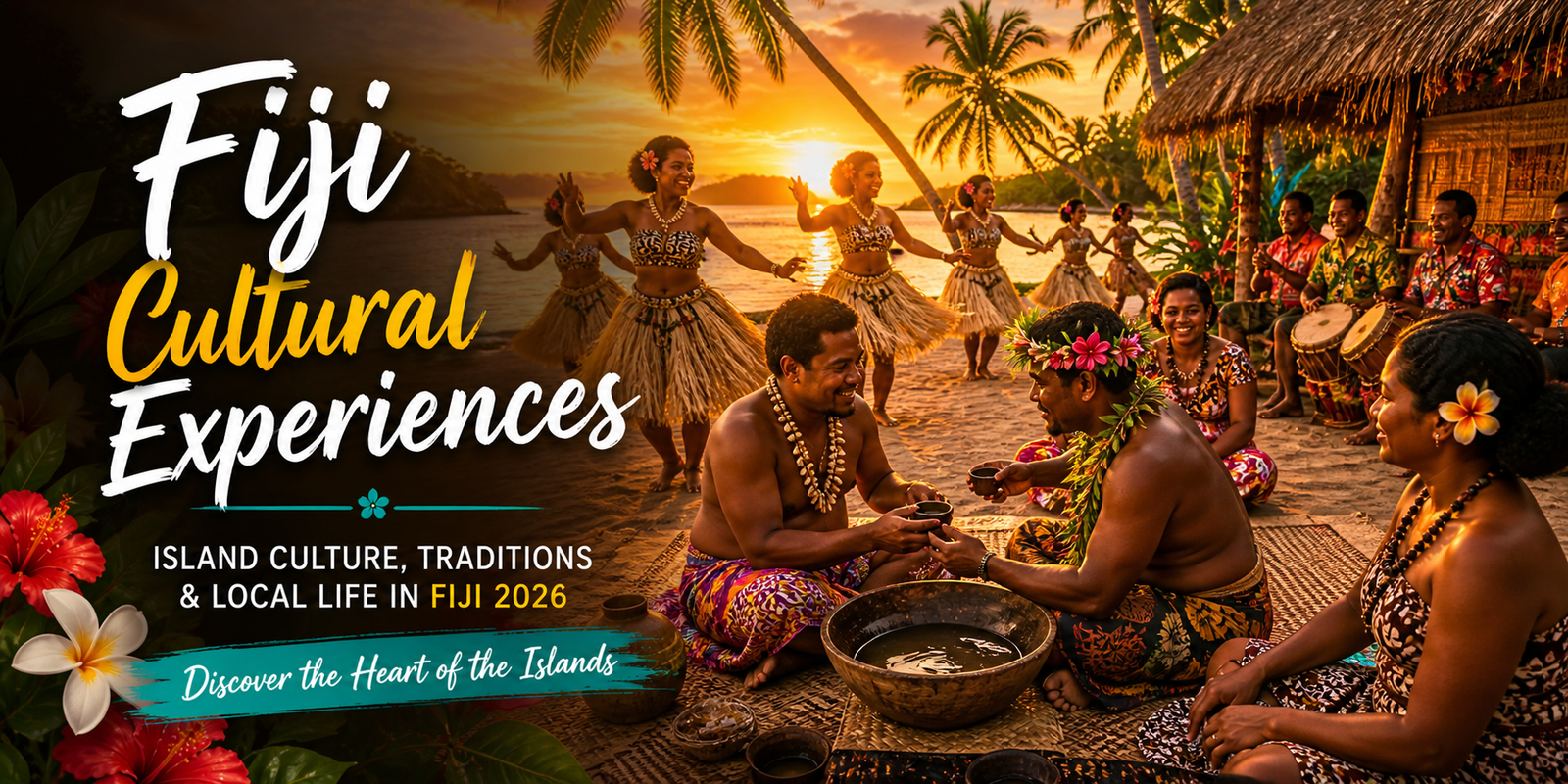
Fiji cultural experiences — honestly, it can start to sound like a checklist. Like something you just tick off. If you’re not paying attention, anyway. Village visits. A kava ceremony. Watching a
meke dance performance. Tasting food cooked in a
lovo underground oven. Learning a few words of Fijian. Sitting with someone while they explain what
vanua actually means—because the translation gets tricky.
But stripped down, it really just means spending time with
Fiji culture on its own terms. Not through a glass partition. Not from a distance.
It means being invited rather than just observing.
Seeing vs Experiencing
Here is where the reflection gets interesting.
You can see plenty. Doesn’t mean you experience much.
Watch someone weave a basket? Fine. Sit beside them while they show you how to start that first loop? That’s different.
Photograph a village from a bus. Or walk in blind. Totally different.
One is collecting images. The other is collecting moments that stick in a different way.
Participating in something asks something small from you. Attention. Patience. A willingness to feel slightly out of place for a minute. Most Fiji cultural experiences are not complicated. Nobody’s expecting an expert. The bar’s low. Really low. Show up. Be curious. Say
vinaka when someone offers you something.
That is basically it.
But the gap between passive tourism and actual interaction is where the memory lives. One fades. The other tends to linger.
Can You Still Enjoy Fiji Without It?
Yes. Absolutely.
Thousands of people visit Fiji each year. Nice resorts. Never touch a single “cultural activity.” And honestly? They go home happy. Genuinely. Their trip was not fake. Their enjoyment was no less valid.
Some travelers go to Fiji specifically to disconnect. From work. From plans. From the mental load of coordinating things. For those people, the idea of adding one more
thing to do in Fiji—even something meaningful—feels like homework.
That is fair. That is honest.
People travel for different reasons. Someone running on empty? They don’t need philosophy. They need a nap. They need sleep, sunlight, and nobody asking them for decisions.
So the question is not whether a trip without cultural depth
can be enjoyable. Clearly, it can.
The question is whether it counts as a
true Fiji vacation. And that just depends on what “true” means to you. Simple as that.
What Might Be Missing
Let us gently explore the other side, without turning this into a lecture.
If a trip to Fiji includes nothing but resort life and organized excursions with other tourists, something does get left behind. Not intentionally. Not maliciously. Just by default.
What gets left behind is understanding.
You leave knowing how the water looked but not how the people laugh. You remember the cocktails but not the way someone says
“no worries” like they actually mean it. You saw the place. You just did not meet it.
There is also something about the unpredictability of real interaction. A scheduled snorkeling trip goes exactly as planned. A village visit where a child grabs your hand and pulls you toward something unexpected? That is not on any itinerary. That cannot be booked. And that is precisely why it ends up being the part people talk about years later.
Without
stepping into Fijian culture at all, you miss the chance to be surprised by a place. And surprise is often where the best travel stories come from.
Why Cultural Moments Tend to Stay Longer
Human connection works differently from scenery.
A beach is beautiful. But a beach does not look at you and smile. A sunset does not ask where you are from. A resort pool does not laugh when you mispronounce a word and then gently correct you.
Authentic Fiji travel—the kind where you actually interact with people—creates memories that have an emotional texture. They are not just images. They are feelings wrapped in specific details. The sound of someone singing while preparing food. The weight of a woven fan someone handed you as a gift. The slight bitterness of
kava and the way everyone claps once afterward.
Scenery fades into a general impression of
“it was gorgeous.” But the unexpected moments tend to stay sharp.
Doesn’t mean one’s better. Just different. Different souvenirs, different feelings. One fits in a photo album. The other fits somewhere deeper.
So, What Makes a “True” Vacation?
This is where we stop trying to give you a straight answer. There’s more than one answer.
For some, a true vacation is just… getting away. No strings. No obligations. No learning curve. Just rest.
For another person,
true means returning home with a different understanding of the world.
Most people? They land somewhere in the middle.
So here’s a thought. Maybe that whole question — “Can you have a true Fiji vacation without real Fiji cultural experiences?” — maybe that’s the wrong question entirely.
Try this instead. What kind of traveler am I today? And what do I really want to bring back? Not what sounds good on paper. What actually matters to me.
That shifts everything. Here’s the thing. Once you go there, it stops being about Fiji. It becomes about you.
Take a family that’s had a hard year. They just need rest. Sleep. Not having to think. Cultural stuff can wait.
But a solo traveler looking for meaning? That person might feel ripped off if they never stepped outside the resort. And honestly? That’s fair too. Neither is wrong. Both are making choices that fit their own version of
truth.
So anyway. Back to the original question.
True Fiji vacation — can you have one without a village visit? Without kava? Without ever learning what
vanua means?
Yes. Probably.
But when you do include that stuff? Yeah. Different vibe.
Not saying it’s morally better. Just… more textured. More human. More likely to hit you out of nowhere six months later — stuck in traffic, and boom, you remember someone singing on a hot afternoon.
Maybe that matters to you. Maybe not. Both are fine.