
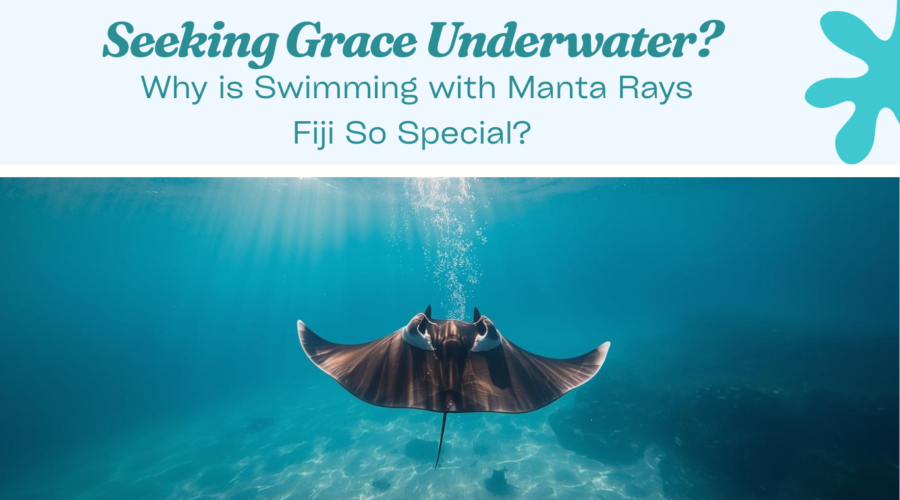
Seeking Grace Underwater? Why is Swimming with Manta Rays Fiji So Special?
We need to talk about the mantas themselves. You can look at pictures of manta rays all day. But until you’re in the water with one, you don’t get it. It’s not their size. It’s their grace.
They don’t swim. They glide. No rush, no splash. Just a quiet, powerful kind of peace moving through the water. That’s the core of any swimming with manta rays Fiji adventure—it’s calm, not chaotic.
They’re gentle by design, these giants. Their entire existence revolves around sifting microscopic plankton from the water with specialized gill plates. You are neither food nor threat. You are simply… there. And sometimes, they seem mildly interested in that fact.
That’s the best part. Their calm makes this possible for almost anyone.
This isn’t a chase. It’s not some predator-prey drama. It’s a shared moment of quiet, and all you have to do is float there. It’s a quiet coexistence.
Why Fiji? It’s All About the Current Kitchen
So, why Fiji? Simple: geography and respect.
The Yasawa Islands funnel ocean currents into narrow channels. This concentrates plankton into a thick, all-you-can-eat soup. For manta rays, it’s a reliable buffet. They show up like clockwork, especially from May to October. This isn’t a show—it’s their daily commute, creating the perfect setting for swimming with manta rays Fiji.
But the real secret is Fijian stewardship. Local villages enforce tabu, or protected zones, where fishing is forbidden. The tabu zones aren’t for show. They’re a promise to protect the vanua—a pledge made generations ago. When you swim here, you’re a guest in their home. Your guide isn’t just a guide. They’re a keeper of that promise. Their knowledge runs deep, and their respect for the rays runs deeper.
You’re not just seeing nature here. You’re seeing a pact—one that’s been honored for generations.
What a Morning with the Mantas Really Feels Like
Forget the brochure. Let me tell you how a morning of swimming with manta rays Fiji actually unfolds.
It starts early, with a boat ride across water so blue it looks edited. The Fijian crew is chatting, pointing out islands. The vibe is excited but calm. Then, the engine drops to a purr. The spotter up front is pointing. “There, by the reef edge. Two of them.”
Your heart does a little flip. The guide gathers everyone for a briefing that’s less about rules and more about philosophy. “Move slowly. Let them come to you. No touching—it hurts their skin. Just float and enjoy.” It’s about being a good guest.
Then you’re in the water. The warmth is immediate. You’ll fumble with your mask—everyone does. You slowly get your breathing under control. Then you look down.
For a heartbeat, it’s just blue. Endless, empty blue. Then, movement. A shadow peels away from the deep blue. It becomes a shape.
And my god—it’s bigger than you ever pictured. It’s coming up from the depths, wings rippling. It passes within a few meters, completely ignoring you, focused on the invisible plankton trail. You can see the unique pattern of spots on its white belly—its fingerprint. You might see it open its giant, cavernous mouth to feed, or perform a graceful barrel roll.
The weirdest part? The quiet. Aside from your own Darth Vader breathing through the snorkel, it’s silent. People don’t yell or splash. They watch. You might exchange wide-eyed glances with a stranger, sharing a wordless “Can you believe this?!” It’s a shared, almost reverent moment. Time does something strange. It stretches out, then snaps back. You’ll get chilled and not even notice. Your mask is foggy and you barely notice. All that exists is the ray and the blue.
Tackling the Nervous Questions Head-On
The big one: are they dangerous?
Honestly? No. They’re gentle giants—literally built to eat the tiniest food in the sea. They have no stingers, no teeth for biting. The only thing you might hurt is the snorkeler next to you if you kick out in excitement.
Do I need to be Michael Phelps?
Not even close. You need to be comfortable floating in deep water. That’s really all it takes. They’ll pass you a pool noodle or a life jacket. You’re just lying there on the surface, peering down.
What if I panic?
Tell your guide. They’ve seen it all. They’ll help you back to the boat or the trailing line. There’s zero shame in it. This is about enjoyment, not endurance.
The mantas here are used to polite company. They don’t panic. No drama. Just quiet coexistence.
The One Rule That Matters Most
This isn’t a petting zoo. The single most important thing you can do is practice passive observation. We have this innate desire to connect by touch, but for mantas, our touch damages the protective mucus coating on their skin, leaving them vulnerable to infection.
The ethical experience of swimming with manta rays Fiji is built on “look, don’t touch.” Don’t chase them. Don’t dive down on them. Let them control the proximity. Here’s the raw truth: that’s the only way it keeps working.
If we spook them, they leave.
By doing nothing—by just watching—you’re not just following a rule. You’re keeping the magic alive for you, and for whoever floats here next.
Choose an operator that vocalizes these principles. The best ones are often smaller, connected to conservation projects, and fiercely protective “of their” rays.
So, should you go?
Listen—if you need jet-skis and constant excitement, book a different tour. This one has quiet stretches. You might float for twenty minutes before you see a thing. That’s the real draw of swimming with manta rays Fiji.
That second—when a ray banks and passes beneath you, close enough to see the water move over its skin, but still completely free—that’s the whole point. It doesn’t feel like something you booked. It feels like a gift.
But if your idea of a perfect morning is calm water, a slow heartbeat, and the chance to swim with manta rays fiji as they move through their world without noticing you… Then yeah. You should go.
The Afterglow
You’ll climb back on the boat buzzing. Someone will finally break the quiet with a “Wow!” and then everyone is talking at once, comparing what they saw, pointing out unique markings. You’ll sit in the sun, salt tightening on your skin, with a quiet, settled kind of gladness you can’t force.
You’ll remember the specific pattern of spots on the belly of the ray that circled you three times. You’ll remember the silence.
That’s what you’re actually signing up for. You’re not buying a guaranteed photo op. You’re buying a chance to float in blue silence and have a wild, winged ghost choose to share its space with you. It’s a gift. And it’s worth every penny.