Beyond the Resort: What’s Cooking in Nadi’s Fiji Street Food Stalls?
Most Fiji visitors stay inside their resorts. Buffet breakfast. Pool lunch. Hotel dinner. Easy. Predictable.
Nadi’s food stalls are right outside. This is where you find the real Fiji street food.
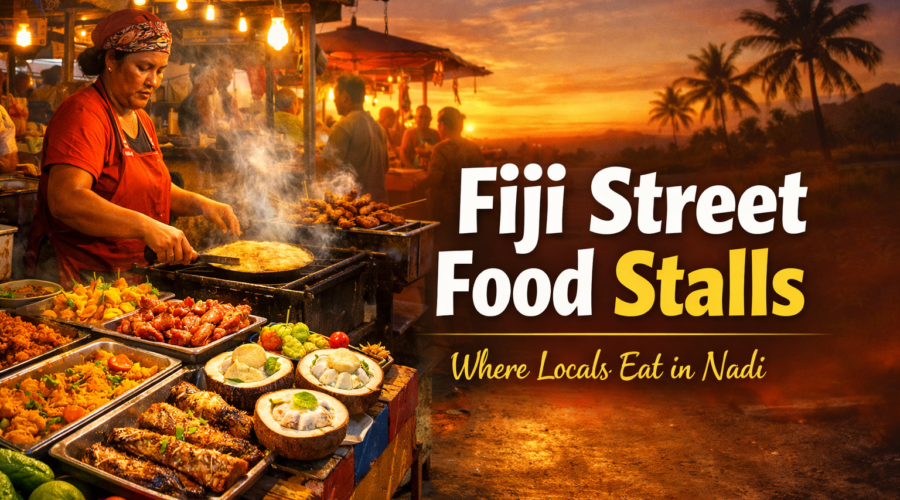
Main road. Market edge. Parking lots after dark. Tables fold out. Burners click on. Ice boxes hit the pavement. By 6 p.m., charcoal glows behind the bus station. Fish and curry smoke drift through waiting traffic.
Where the Food Stalls Are
The Nadi Municipal Market is the main hub. The building itself is nothing special—concrete floors, open sides, rows of tables. But inside, the prepared food section runs along one wall. Women sit behind steel trays. Roti here. Fried fish there. Vegetable curry in the middle. Rice goes into banana leaves or foam boxes. Cloth towels keep everything warm.
Midday heat slows things down. Some stalls close. Others serve less. Saturday mornings are packed. Sunday is slow.
A second cluster of stalls operates along the stretch of road near Namaka, closer to the airport. These cater largely to local workers and families running errands. Tourists rarely come here. Not because they’re unwelcome. The stalls just aren’t near the hotels.
At night, smaller setups appear near the Nadi traffic lights and outside a few supermarkets. Usually just one item per stall. One man works a grill. One woman tends a pot of curry. Someone else sells Kokoda by the cup from a cooler box.
What’s Being Cooked
Fiji street food is not like Bangkok or Mexico City. Late-night snacking is not really a thing here. This is meal food. Breakfast. Lunch. Dinner. It is made fast and eaten fast.
Seafood and Fish
The fish is scored with a knife. Salted. Turned once. That is it. No marinade. No sauce. Just a wedge of lemon or lime. Maybe a small container of chili paste on the side.
Kokoda is also common, but not at every stall. You find it at places that specialise. Served cold. The coconut cream is usually freshly pressed. The texture and taste are different from canned.
Roti and Curry
The roti is soft, thick, and oily. Not like paratha. More like a flour tortilla. Cooked on a flat griddle. A tawa. Sometimes held over fire to puff up.
Curry changes by stall. Chicken is standard. Cooked until it falls apart. Goat or lamb at older Indo-Fijian vendors. Potato curry for vegetarians. Gravies are thin and spicy. You mop them up with roti. No spoon.
Samosas are everywhere. Small. Stuffed tight. Fried in dark oil that’s been used all day. Vegetable filling has cumin seeds and green chili. Meat samosas are harder to find.
Fruit and Drinks
The same fruit is sold inside the market.
Young coconuts opened on the spot. Top chopped off with a machete. Straw in. Handed over. Water is faintly sweet, clean. Drink it down, bring the coconut back. They crack it open. You scoop out the soft meat.
Sugarcane juice comes from mechanical rollers. Only certain stalls have them. Liquid runs out green, foamy, and very sweet. Served over ice in a plastic bag. Straw poked through the side.
Fried Snacks
Babakau is the most common fried Fiji bread. Some stalls serve it alongside curry in place of roti.
Cassava chips are cut thick. Much thicker than bagged potato chips. Fried until crisp. Salted. Sometimes, a dusting of chili powder.
They go stale fast. The best batches are small and made throughout the day.
How the System Works
Ordering Fiji street food follows a pattern that is consistent across most stalls.
Customers approach and are greeted. If they don’t speak Fijian or Hindi, pointing works. Vendors are accustomed to non-verbal ordering. Prices are either displayed on handwritten signs or simply known by regulars. A roti wrap costs between FJ$4 and FJ$7. A container of Kokoda runs FJ$8 to FJ$12. Grilled fish is priced by size, usually FJ$10 to FJ$15.
Payment is always in cash. Small bills are preferred. Few stalls can break a FJ$50 note.
Food is served immediately. Most stalls don’t have seating, but the Nadi Market has a few shared tables near the food section. Customers eat quickly. There’s no lingering.
What Travelers Should Know
First-time visitors to the food stalls in Nadi Island Fiji often have questions about safety.
The simplest rule is to follow local customers. A stall with a line of Fijian and Indo-Fijian customers has good turnover. Food isn’t sitting out. Oil is fresh. Ingredients are moving.
It’s also useful to watch the cooking. Vendors who handle money and food with the same hand are rare. Most keep clean hands for preparation and assign a separate person, or a separate hand, for cash. Stalls that have been around for years do things the same way. Regular customers expect it.
Grilled fish. Fried samosas. Hot curry. Less risk than raw dishes. Kokoda, while acid-cured, is still raw fish.
Who Eats Here
The customer base at Nadi’s street stalls is mixed.
Families stop for fried snacks after school pickup. Older Indo-Fijian men sit and drink tea at stalls run by people they know.
Tourists come through, but not many. A couple of stalls near the market entrance have English signs. Bigger print on price lists. That is the only change. Everything else runs the same as always. No tourist menu. No marked-up prices.
What the Food Actually Tastes Like
Local food in Fiji is not defined by what is added. It is defined by what is left out.
No cream sauces. No reductions. No emulsions. No plating. No garnish. A grilled fish comes out whole. Sitting on a scrap of foil. That is it. A roti wrap is handed over in butcher paper. Curry comes in a foam container with no separate compartment for rice.
Why People Come Back
Regular customers at Nadi’s Fiji street food stalls don’t return because the food is cheap, though it is. They don’t return because it’s convenient, though it is that too.
They return because a particular stall makes roti the way their grandmother made it. Or because the fish vendor remembers their name. Or because after ten years of eating lunch at the same plastic table, the routine itself has become familiar.
For visitors, one meal won’t create that kind of attachment. It shows what everyday eating in Nadi really looks like. Not the tourist version. Not the resort buffet version. Just food that people here cook for each other, day after day, in the narrow space between the produce tables and the parking lot.
One Meal
A person walks from a Denarau resort to the Nadi Market. Orders a roti wrap from a stall near the entrance. Eats it standing up near the fish section. This is not some life-changing meal. The roti is a bit greasy. The curry might be hotter than expected. The plastic table wobbles.
But the woman who cooked that roti has been making them since she was twelve. She stood beside her mother at this same stall. The fish in the curry was caught yesterday. Sold this morning to a vendor she has known for twenty years. The chili in the paste came from a farm up in the Nausori highlands.
That meal happens in a crowded market. Trucks idle outside. Vendors shout prices over the noise. None of this is a performance. It is not Fijian culture staged for visitors. It is just dinner.
For the time it takes to eat, that person is not a resort guest. Not a tourist. Just someone in Nadi, having something to eat.