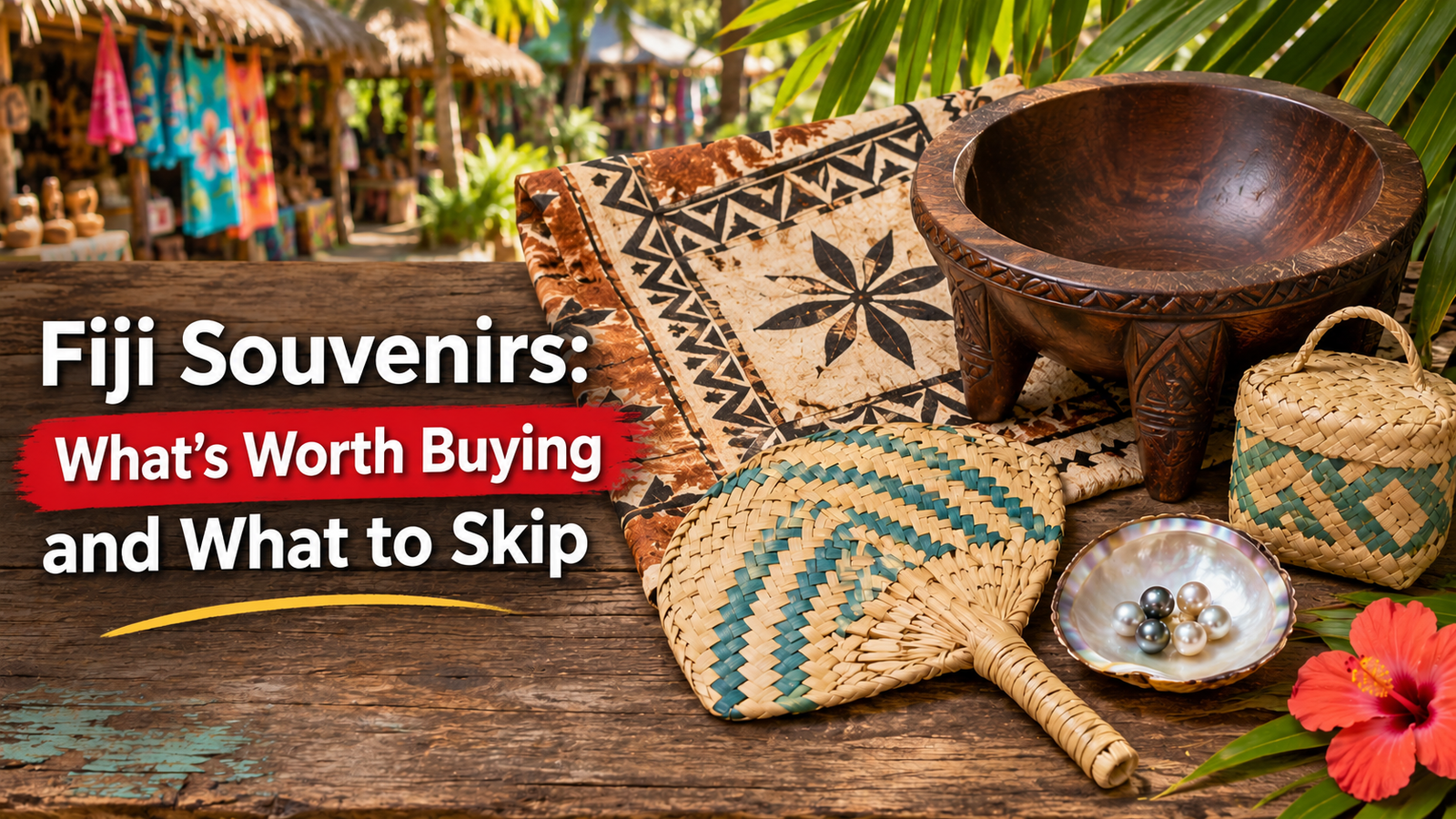
Many souvenirs from Fiji are available, including beautifully crafted masi cloth, carved kava bowls, and plastic souvenirs that may have originated anywhere. They aren’t always easy to spot in shops, and some of the traditional goods at retail stores are manufactured or imported.
Not all the items have been purchased by us personally. The guide is sourced from Tourism Fiji, travel guides and shopping directories, and ‘we say’ for any information we have been unable to verify. We have omitted prices as they can differ greatly from market to market, resort to resort and seller to seller and to quote an accurate price.
Souvenirs from Fiji that you should buy.
Masi (bark cloth)
The paper mulberry tree is used for masi and it is inked with black and brown natural dyes. According to Tourism Fiji, it is traditionally worn on special occasions and handed down from generation to generation, and there are different motifs for each region. According to Outlook Traveller the painted bark cloth is associated with the Lau Islands and is created by women in Fiji.
It is light and flat, it fits easily in a suitcase or bag and it can be used as a wall hanging or gift. One older guide, Frommer’s, states masi is the only thing that one can be certain is a true Fijian handicraft; most of the items sold are not.
Tanoa (kava bowl)
The kava ceremony is centered around the carved four-legged tanoa. Most are simple and functional, but there are also decorated ones available to hang. If you’re interested in having one made, purchase it from a reputable shop or a trusted carver.
Weaving mats, baskets and fans
They are handmade from reeds, pandanus or leaves of the coconut tree. Tourism Fiji calls them sustainable and travel-friendly, but warns: “Be sure to review the importation policies of your country regarding plant-based items.
Clubs and lali drums that are carved.
In the past hardwood clubs were also used for warfare and are now predominantly used for decoration. Tourism Fiji recommends that you purchase only from a reputable shop or trustworthy carver, and states that they can be heavy, so be mindful of your bag allowance. The smaller lali drums are sold as playable souvenirs and are used as a traditional signal to gather in the village.
Pearls
Frommer calls the Savusavu pearl farm, J. Hunter Pearls, the best pearl farm in Fiji, and mentions the yellow pearls called Fiji Gold. Savusavu is located on Vanua Levu and most will purchase from other sources. FijiPocketGuide cautions that the pearls in certain chain jewellery stores are actually not from Fiji, but from the South Pacific region. For a Fiji pearl, inquire where the pearl was farmed.
Kava
Kava is a common gift to take back with you and Jack’s of Fiji and the municipal markets listed in FijiPocketGuide are places to obtain kava. Beware of customs – we discuss that below.
Clothing and small gifts
According to Outlook Traveller, sulu wraps and bula shirts with flower designs are readily available at the markets and at stores such as Jack’s. Tourism Fiji recommends Jack’s Handicraft, which has an extensive range of small, suitcase-friendly items like jewellery, carvings and textiles. Locally produced chocolate is generally recommended, along with Pure Fiji skin care products, though food items follow their own customs regulations. For more ideas beyond handicrafts, browse our Fijian products guides.
Things to Avoid or Take Care Of
Look-alikes from imports and made by machines. Today, many carved items are machine-made, as are many of the smaller ones imported from Asia, cautions Frommer’s. Wherever an item is inexpensive, inquire about its origin if it is the same in all stores.
Turtle shell, giant clam and coral. According to one guide, these can be protected and are not allowed to be exported. There is no official source we could find in our research, check Fiji officials or your country’s customs regulations before purchasing any shell or coral product.
Street sword sellers. Someone who approaches you on the street with an artefact may carve your name on it and then ask you for payment or a donation, warns Tourism Fiji. Instead, say no thanks before they begin to carve and then walk away. Don’t purchase in remote areas or think you should purchase just because you feel pressured.
Novelty cannibal forks. They’re found in almost any souvenir store, writes Culture Trip. Treat them as tourist items rather than heirlooms.
How to Shop Well
- Purchase from a reputable shop or a trusted carver, particularly for carvings, Tourism Fiji recommends.
- Check and select from several stalls, comparing prices, before purchasing.
- Understand when bargaining is applicable. Bargaining at markets is normal, even among the locals, but most of the shops in the resorts and galleries have set prices, says Tourism Fiji. Have small bills of cash for markets.
- Ask who made it. It’s easy to ask a question, and a seller who knows the maker will probably have a story to tell.
Where to Buy Souvenirs From Fiji
- Nadi Handicraft Market and Suva Municipal Market. The best places for woven mats, masi, baskets, fans and carvings that you can find in Tourism Fiji.
- Pop-up and community markets. The RoC Market, Garden City Market, Damodar Night Market in Suva, Vuda Market near Nadi and Lautoka are the key markets identified by Tourism Fiji. According to Outlook Traveller the RoC Market in Nadi is on the third Sunday of every month, so please check before you go.
- Jack’s Handicraft. A large store that carries a broad selection, which comes in handy if you’re looking for multiple gifts from the same store.
- Baravi Handicrafts. It may be handy if driving between Natadola Beach and the Coral Coast on the Queens Road at Vatukarasa, Coral Coast. One person with a listing states that they will be open from 6 am until 9 pm each day, but double-check. The area is covered in our guide to Natadola Beach and the Coral Coast.
- Collectives and social enterprises. Tourism Fiji features Pacifique Artisans Collective in the Suva Flea Market; Projects Collective at Beachouse Fiji Resort in Nadi and Sabeto Shed Shop and Port Denarau.
- Nadi Airport. If you left something at home, there are large shops in the departure lounge, as mentioned in Frommer’s notes.
What’s open and closed on a Sunday. Our guide to what’s open and closed on Sunday may help. See our things to do in Nadi guide for ideas on how to fit shopping into a Nadi day.5
Taking Souvenirs Home
Tourism Fiji recommends that persons to declare items such as wooden items, shells or naturally made items from plants as they are not likely to be confiscated or are likely to be fined heavily. Generally, dry and clean items are OK. Use cloth to wrap delicately carved objects, and roll or flatten woven objects.
There is a special warning for Kava. While it is legal to purchase in Fiji, it does not necessarily mean that it will be legal to import into your own country. The FijiPocketGuide says powdered kava found in paper bags in Fiji markets would not be likely to pass customs abroad. Importation regulations vary from country to country and change from time to time, so it is best to consult the official rules of your customs and biosecurity agency before making a purchase. This isn’t legal advice.
This is also true of shells, coral and any product from animal origin. If you’re not sure, don’t put it in the garden.
A Short List
For something traditional and convenient to carry, begin with a masi (woven fan or mat), and a small carved object from a trusted maker. If you are able to verify where the pearl is farmed, add a pearl.
Fiji Souvenirs FAQs
What are the best souvenirs to get from Fiji?
Some mats, fans, tanoa bowls, woven mats, carved items from well-known craftsmen, and pearls, if you are able to confirm their origin. Wrapped gifts and bula shirts are easy and useful gifts.
Where can you get souvenirs of Fiji?
Well-stocked markets are the town markets, Nadi Handicraft Market or the Suva Municipal Markets, and large stores, like Jack’s. Collectives and community markets are good if you wish to support the small makers directly.
Is bargaining acceptable?
Of course, at markets, but nicely, with a smile. Resort shops and galleries typically have a set price.
How do I know if a gift is genuine or not?
There is no magic test for determining if a word is foreign. Purchase from a reputable store or from a known carver; inquire where and how the piece was created; be cautious of store-bought pieces that are very similar. The one thing an older guide can always count on as being Fijian is masi.
May I take kava home?
This will depend on the country you are in. The purchase of kava in Fiji is legal, however, there are some differences in customs and biosecurity regulations, and kava powder in a paper bag may not be allowed to pass customs. Always refer to the official advice for your country.
May I take shells and coral home with me?
Be cautious. According to one guide, products of turtle shells, giant clam and coral can be saved and are illegal to export. Please consult the official rules of Fiji and your country of origin before purchasing.
Is the lotus sold in Fiji from Fiji?
Not necessarily. Some of the chain shops sell pearls from other parts of the South Pacific. Inquire what the source of a pearl is, or purchase a pearl from a farm.
What kind of mementoes can be easily carried?
Woven fans, jewellery and small textiles are easy. Hardwood Clubs are heavy.
If someone invites me to have my name carved, what shall I do?
Don’t accept the offer before they begin and leave. Tourism Fiji cautions that once you’ve carved your name, the sellers may ask for payment or a donation.
Sources