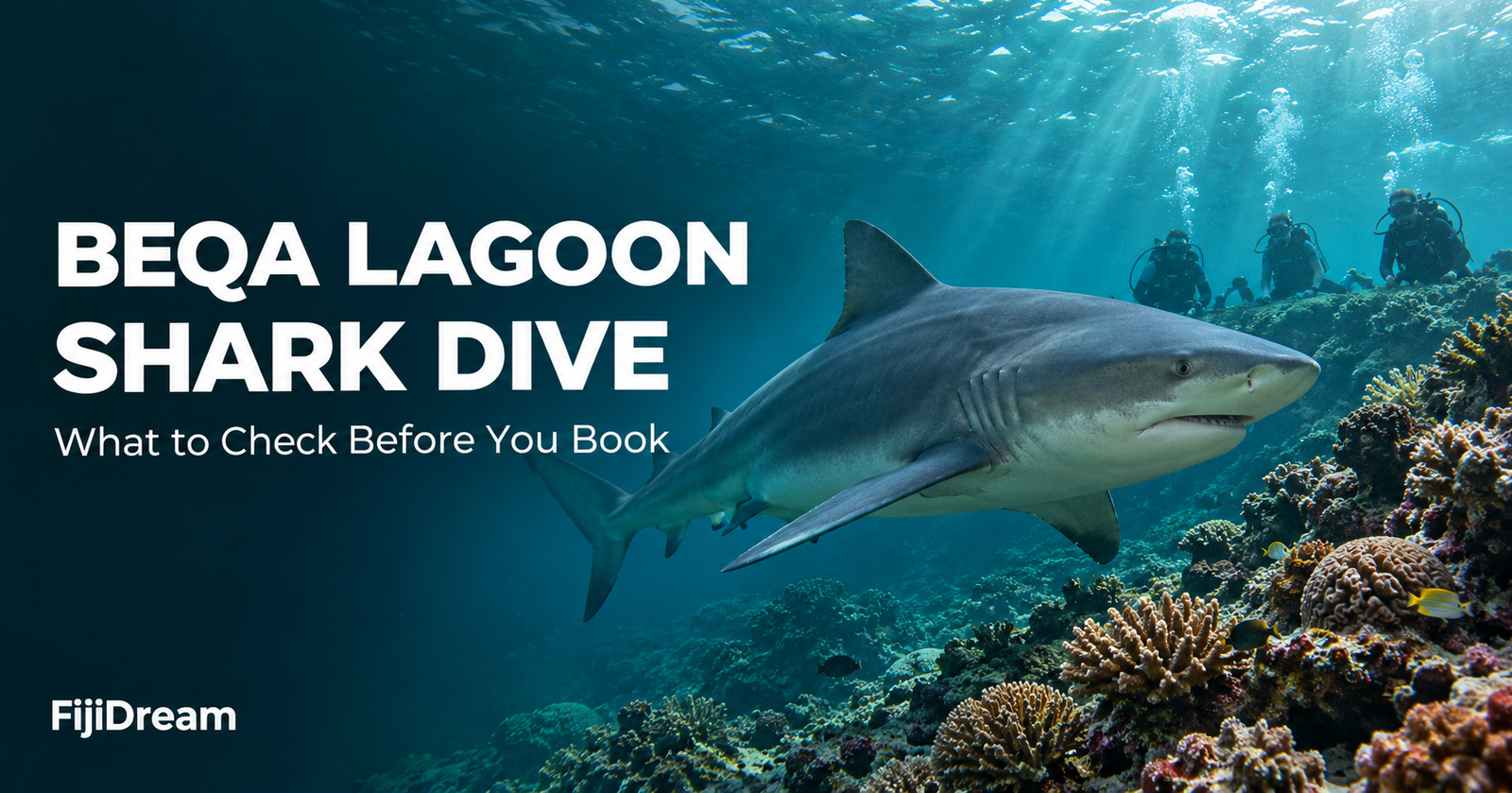
One of Fiji’s most famous shark dives is the Beqa Lagoon shark dive, and one of its most controversial. Divers go down on the reef and bull sharks and other sharks come to the reef and feed on the bait. This is the experience most people mean by the term Fiji shark dive, and it’s concentrated around Pacific Harbour on the southern part of Viti Levu.
This dive has not been made by us. This guide consolidates the information provided by operators, booking listings and published research, and highlights the differences. Specifications, cost and timings vary from source to source, so double-check all these before booking.
What is the Beqa Lagoon Shark Dive?
The dives take place in and around the Shark Reef Marine Reserve, just off Pacific Harbour. The majority of shark dives are conducted by two operators: Beqa Adventure Divers and Aqua-Trek. The typical dive is two dives, and Lonely Planet mentions that they usually take place at the same dive site, sometimes with a reef dive.
According to research papers, sharks have been hand-fed at Shark Reef since 1999! The traditional owners of the reef are the Wainiyabia and Galoa villages, which became the reserve in 2004. Divers pay a small fee to these villages and in exchange, the villagers agree not to fish inside the protected area, according to Scuba Diving magazine.
What It’s Like
In general, it is in the same format between operators. Divers go to a feeding location, position themselves and observe the sharks feeding at them. Scuba Diving is a depiction of some of the diving sites, with fifteen divers kneeling behind a low wall of coral and a bull shark swimming overhead at The Bistro. According to Fodor’s, Aqua-Trek distributes the divers around the perimeter before they introduce a bucket of fish. Over the years the way operators operate has changed, so inquire on the day you’re going.
There is an emphasis on the bull sharks. Scuba Diving: 8 species are found on the reserve, including bull, whitetip, blacktip, grey reef, tawny nurse, sicklefin lemon, silvertip and tiger sharks. Tiger sharks are only occasionally seen. According to Sport Diver, over 200 sharks have been identified and is referring to the largest concentration of bull sharks in the world. Don’t assume that last statement is a fact, just as you can’t assume it’s a fact, it’s a magazine description.
In several sources there are depths of approximately 30 m (100 ft). One advertisement states that the dive is very active and advanced certification is preferred. This dive is an active dive with a lot of structure, not a lazy cruise down a reef.
Who It’s For
It can only be done by certified divers, and one listing calls for reading and signing papers and a pre-dive briefing. In addition, there’s conflict regarding this, and a prudent interpretation is that it’s for divers who are at ease underwater, are extremely buoyant and just don’t give a hoot about big animals.
It isn’t for non-divers. One of the booking sites offers the snorkel option, but we didn’t have confirmation from an operator, so check first before taking it for granted. If you’re certified and not much into a shark feed, you can check out some soft coral dives in Beqa Lagoon as well, and explore more marine life in Fiji. which is a different type of dive altogether.
What to Check Before You Book
Where listings don’t agree, and where a misplaced belief can lead you to miss the dive.
- Certification and experience. One advert will require proof of certification and state that ideally 30 dives are needed and 5 or more at approximately 30 meters. All divers with less than 30 dives should be supervised in the deep section. Another listing also requires full Open Water certification, with advanced certification recommended. Request the operator’s requirements in writing.
- Minimum age. Listings give 10, 12 and 15 years, depending on the operator and the platform. Avoid depending on any of them. Check directly and enquire about the rules for junior certs.
- According to one listing, trips to the morning depart from Fairway Place in Pacific Harbour at 8:00 on Monday, Tuesday, Thursday, Friday and Saturday. The other one has other days. Look at the days and time of day.
- It is essential to understand the price and what is offered. Third-party prices are around US$160 to US$225 per trip (usually two tanks), and one source lists gear hire at about FJ$20 per piece or FJ$50 per day for a full set. Confirm that tanks, weights, gear and transfers are included, and that you are being charged in which currency.
- Transfers and location. One listing states that round-trip shuttles run to Pacific Harbour area resorts only. Pacific Harbour is approximately an hour west of Suva so it’s a long way from Nadi and Denarau. Be sure to do some research on the drive time before traveling for a day trip, and avoid going far from Pacific Harbour.
- Group size and minimums. One listing has a maximum of 20 divers. The other one needs to be operated by a minimum of four people.
- One listing recommends not diving during the first 48 hours after your flight. Do listen to your dive agency and the operator and schedule the dive early in the trip, not right before the flight home.
- Ensure that your dive insurance policy includes this type of dive.
- Weather and cancellation. Discuss what would occur if the boat fails to run.
Is the Beqa Lagoon Shark Dive Safe?
It is not risk-free and any listing that states otherwise is not trustworthy. Some of the booking pages use marketing terms like perfectly safe. Project Abroad, an organisation focused on volunteering, reports that on their trips the operator has not had any incidents or injuries that involve sharks. This is a partner’s statement which we could not substantiate independently.
The only thing I can say for certain is that the dive has a procedure to follow and is guided by experienced people and the briefing is supposed to be adhered to. Diving is dangerous in general-even without the sharks.
The Feeding Debate
The scheme for provisioning sharks for tourists is indeed debatable. This is how the critics put it with scuba diving: long-term feeding might change the natural behavior of sharks and make them reliant on divers.
A long-term study of bull sharks conducted at Shark Reef by Juerg Brunnschweiler and Adam Barnett is the most famous study at this location. It concluded that the sharks were not well conditioned and that the feeding did not apparently influence the long-term movements of the sharks. The authors note in their summary that decades of feeding could still be to blame for attracting sharks to the area.
There is, however, less positive research. It’s also pointed out in a later paper on Beqa Lagoon that, based on a bioenergetics model, some sharks would have been able to subsist on provisioned food alone, but that isotope study revealed that tuna heads made up only a small portion of their diet. An investigation of the effects of long-term feeding in Moorea, French Polynesia, revealed negative consequences for lemon sharks. It is a different species, different place, so it’s not a translation per se.
There isn’t consensus in the science. If it’s important to you, ask the operator how the feeding is handled, what research it’s conducted to support, and what conservation money it’s generated from, and make your own decision.
Best Time to Go
The dive is described as running all year round (25-29 degrees Celsius). If you are traveling in cyclone season (November to April), try to be flexible as trips by boat may be cancelled in bad weather.
Beqa Lagoon Shark Dive FAQs
What is the price of a Beqa Lagoon shark dive?
The trip on a third-party listing costs about US$160 to US$225. Please check prices with the operator, platform and date to be sure.
Do I need to be certified?
Yes. It is advertised as being for certified divers only. Experience may be required, please check with the operator.
What’s the lowest age?
Listed for 10, 12 and 15 years, depending on the operator. Check with the operator before booking.
How far down is the dive?
There are several sources that suggest a maximum of approximately 30 meters (100 feet).
What kind of sharks are there?
Eight species are found in the reserve. There are almost exclusively bull sharks here, and occasionally tiger sharks.
Is it safe?
Follows a protocol – not risk-free. The operators and partners report no injuries related to sharks on one operator’s trips, but we were unable to independently confirm this.
Is shark feeding ethical?
It’s debated. Limited effects are suggested in research conducted at Beqa Lagoon, but concerns are raised in other research. Inquire of operators how they operate the dive and their role in conservation.
The distance between Pacific Harbour and Nadi is how many kilometers?
It’s a long drive. Pacific Harbour is approximately one hour west of Suva and though we haven’t personally visited Nadi please check before making a day trip.
Can non-divers join?
One of the two booking websites has a snorkeling option but we were not able to check it. Ask the operator.
What are the shark dives in Fiji run by?
Beqa Adventure Divers and Aqua-Trek are the two main operators in Pacific Harbour, according to Lonely Planet. You may have other operators, check them out for their running status.
Sources
-
- Brunnschweiler and Barnett: Opportunistic visitors, long-term behavioural response of bull sharks to food provisioning in Fiji (PLoS ONE, 2013)
- Undercurrent: New research, shark feeding may not affect behavior (2013)
- Scuba Diving: How do you save a shark? Dive with it! (2022)
- Pelago listing: Ultimate Shark Encounter two-tank dive
- Projects Abroad: Shark conservation in Fiji