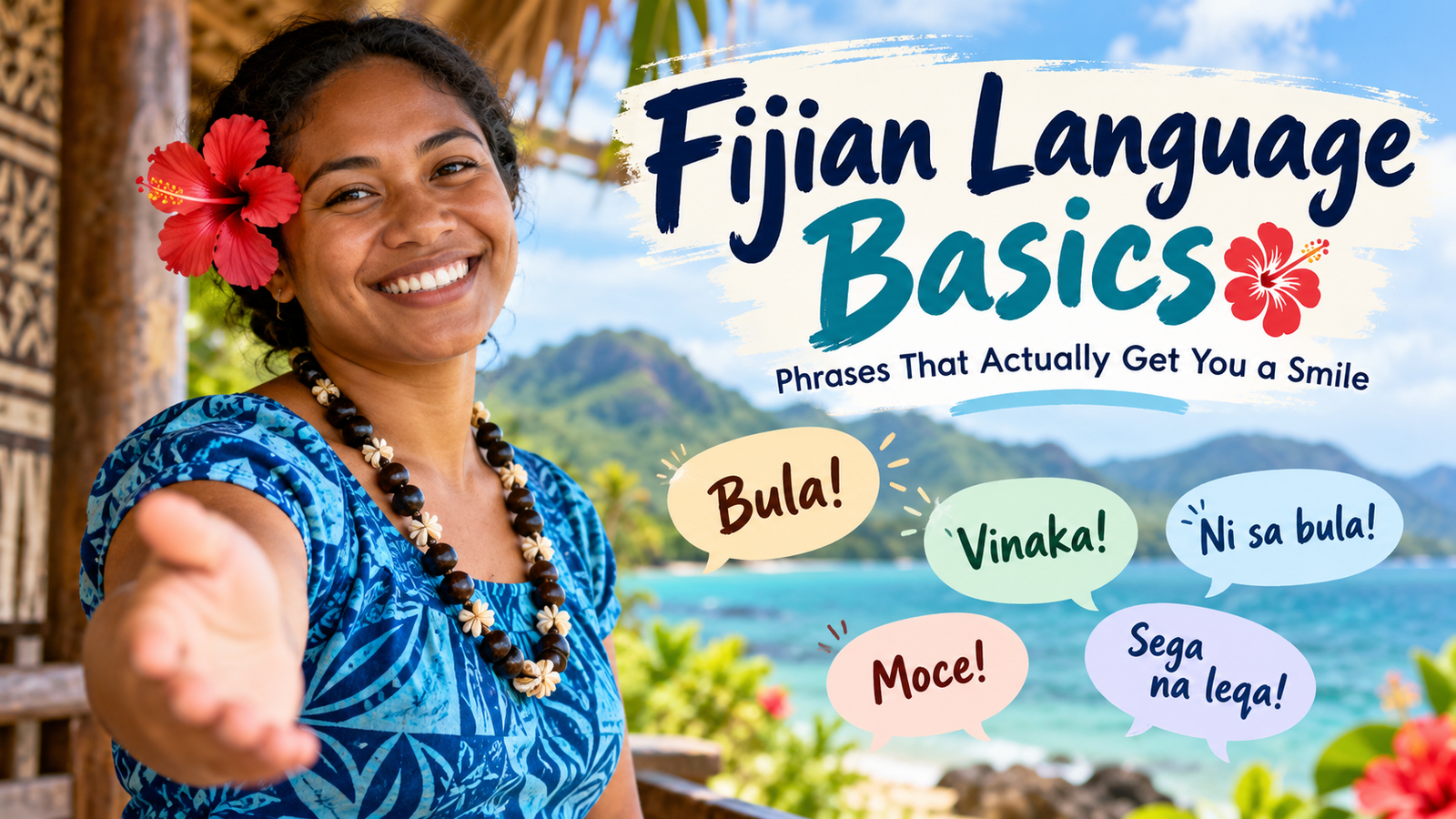
You don’t need to speak Fijian to appreciate the impact of a handful of Fijian words. The whole tone changes when you say “bula” to a store clerk, as opposed to “hi”. Sometimes a smile grows larger, the tone warmer, or maybe a spontaneous laugh over making the effort. That is the argument for learning the basics of Fijian before you travel: it’s not about getting by; it’s about being treated differently because you tried.
Fortunately, Fijian is much easier to approach than most visitors think. Most of the time, a few words, if spoken correctly, will get you through – and it’s not the words that most people get wrong, but how they say them.
Why Pronunciation Matters More Than Vocabulary
Fijian spelling is regular and consistent after learning the rules, but some letters don’t correspond to the sounds of an English speaker, and if these letters are mispronounced, the word becomes quite different:
- B is sounded with its ‘m’ prefix; thus, bula is actually ‘mbula’ (and not ‘boo-la’).
- C is a “th” sound, like Mama; for example, Mamanutha, not Mamanaya or Mamanayaa, and moce (goodbye) is mo-they, not mo-say or mo-cheh.
- Like the B rule, there is an “n” sound in front of “D”.
- The “Q” is pronounced like “ng” in the middle of “singer”.
- The Fijian alphabet doesn’t include any X or Z.
After the rules click, reading Fijian phonetically is no guessing game. In most cases, the stress is placed on the second-to-last syllable, so vinaka is pronounced vee-NAH-kah and NOT VEE-nah-kah.
The Essentials
Bula (mm-BOO-lah) Hello. This is the most common and widely used word in Fiji at any time of day or night, and in any place, and sometimes with genuine enthusiasm. It literally translates to “life” or “good health. It never goes out of place; use it all the time.
A more formal form of bula, used when greeting an elder, chief, or someone you wish to express greater respect for. It will stand out in a village if you use it instead of a casual “bula.
Thank you! Vinaka (vee-NAH-kah) is one of the most important words in the Fijian language – and you’ll never sound too much when using it!
Vinaka vaka levu (vee-NAH-kah vah-kah LEH-voo) means ” thank you very much, literally “big thanks. Good to use when someone has been doing something nice for you.
Yadra – Good morning. This is a little detail that the locals catch about swapping this in for bula before noon.
Moce (MO-they) = Goodbye, literally “sleep. The “th” sound is important to remember in this case; this is one of the words that visitors often mispronounce.
Io (EE-oh) – Yes. Sega (SEHN-gah) — No.
Please (kerekere): Used when asking for a favour or assistance, not as a general ‘please’ to signal something.
Beyond the Basics
But there are some phrases more than meets the norm, and they make a better impression, particularly because most visitors don’t know them:
Thank you / excuse me.
Sega na leqa (SEHN-gah nah LEHN-gah) – No worries, which is the roughly translated version of ‘no problem’ or ‘it’s all good’ in Fiji. It’s the only time when it’s really useful, during the leisurely hours of “Fiji time”, when a bus or ferry is late, and you need to get very angry, but it won’t make any difference.
Au lako mai [country] = from [country]. It is common to be asked by Fijians in the course of conversation where people come from, and it is likely to earn a favourable response if you respond in Fijian (even to a small degree).
The actual locations where this will be used.
Basic language skills are important in different ways across different geographic areas. At a resort, employees will be familiar with guests and will be glad to hear the use of an incorrect bula. In markets and smaller towns, correct pronunciation is critical, for if it is not used, it will be interpreted as a lack of effort, not as a phrase from a resort welcome sign. One of the little things that locals do notice in a village setting, especially during a kava ceremony or sevusevu, is that they use a more formal version of ni sa bula, instead of the casual version.
All this doesn’t require the learning of a phrase book. For most of the day-to-day interactions in Fiji, the words Bula, vinaka and moce will suffice.
FAQs
Which is the most crucial word in the Fijian language?
Bula. It translates to “hello” and applies to almost any greeting situation, regardless of time of day, place, or who you are talking to, even if you learn more.
What do you call “thank you” in Fijian?
Vinaka, pronounced vee-NAH-kah. Vinaka vaka levu is used to emphasize the meaning of your thanks, or to say “thank you very much.
What is challenging about learning Fijian?
There’s a limited vocabulary for basic travel. The biggest problem is with pronunciation, as some letters are not pronounced as they appear to English speakers, especially B, C, D, and Q. With those rules, Fijian is fairly easy to read and pronounce.
Speak English in Fiji?
Yes, English is spoken widely and is one of Fiji’s official languages, particularly in tourist areas, resorts, and larger towns. Learning basic Fijian phrases is not a requirement for communication; it’s about warmth and goodwill.
What’s the difference between bula and ni sa bula?
Bula is an informal, familiar, common verb that is used all the time, in most places. A more formal form of this greeting is ni sa bula, which would be given to elders, chiefs, and to anyone who is in a position that you wish to show great respect to, such as when visiting a village.
What is the Fijian word for ‘goodbye’?
Moce (pronounced “mo-they”) is one of the most mispronounced sounds during a phonetic reading of the word by visitors, and one of the reasons is that the Fijian “th” is different from the English “th”.
Read these articles too: