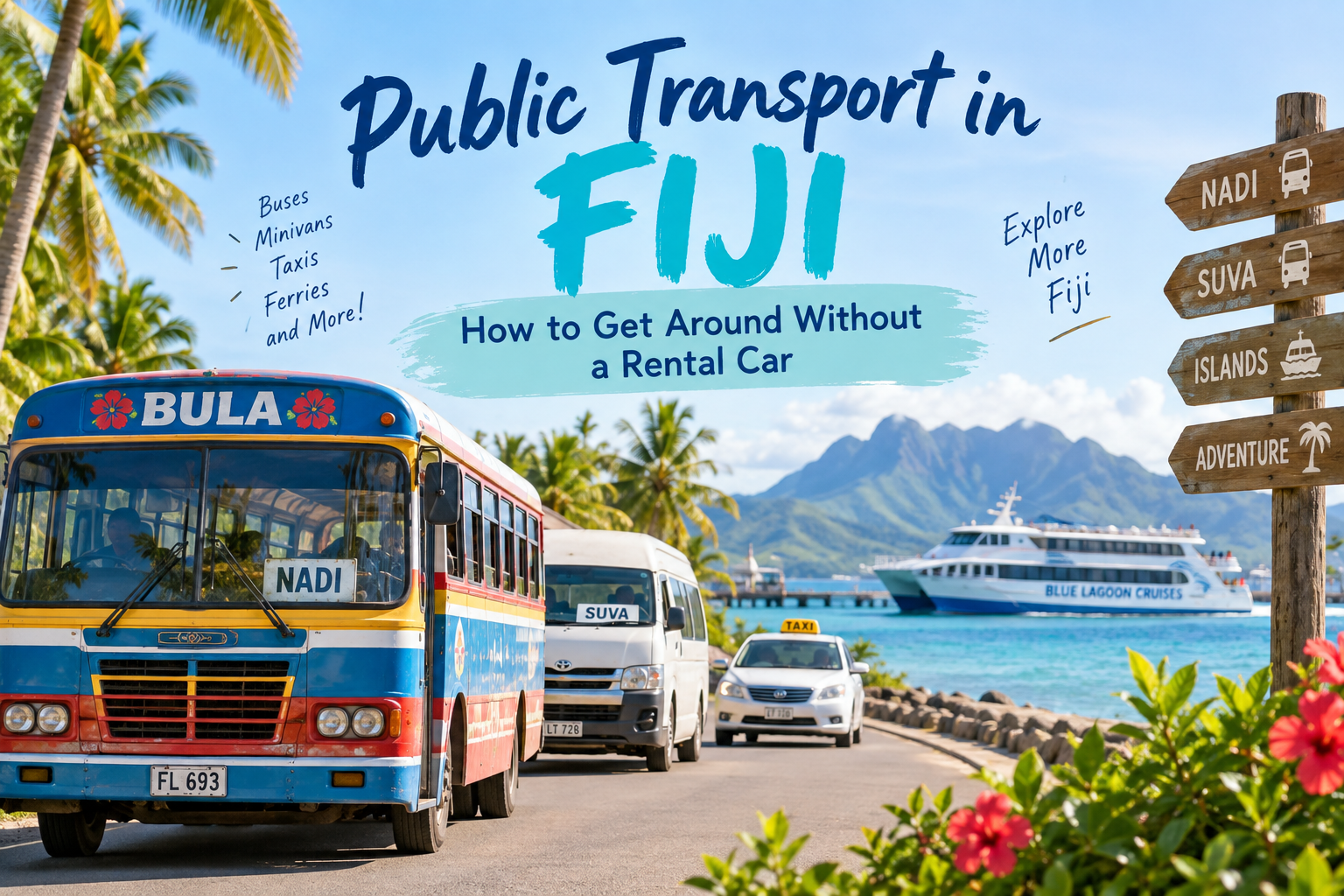
You don’t have to rent a car to visit Fiji, and for many vacationers, it is not the simplest way to travel. Roads are relatively good on the main islands, but driving on the left and the need to navigate unfamiliar towns and pay half the time to park a car at a beach makes for a quick expense. Public transport in Fiji, including buses, minivans, carriers, taxis and inter-island ferries, has almost everything to offer a visitor to the island, and is typically cheaper. Let’s get some clarity on each option.
Local Buses
The main mode of transport in Fiji is buses, and in the islands of Viti Levu and Vanua Levu, about 95% of the country’s roads are used by buses. There are two types: local buses, which run with an open roof, stop frequently, and are filled with a representative cross-section of the day-to-day life of the Fijians, and express buses, which are air-conditioned, follow fixed timetables, and do not make some of the intermediate stops between towns.
Local bus fares are almost always very low – a short journey on a Fiji bus will cost just a few Fijian dollars, while a trip to Nadi from Suva is more expensive at less than the cost of a taxi or private hire. There are reliable schedules for buses on major routes (Nadi–Lautoka, Nadi–Suva); on smaller routes, you can plan around the bus, but may rely on it less than someone with a tight schedule.
Minivans
In most towns, there are minivans (also known as shared vans) that have 10-15 seats and circle the town looking for people to pick up. Generally, they cost the same as buses, but run quicker because they don’t provide fixed routes with fixed stops like express buses. The lone detail to watch: There are actually license plates for “LM” minivans. There are some unlicensed vans that do run and are usually not to be relied upon, as they are not subjected to the same safety scrutiny.
Carriers
The best local – and most primitive – of these vehicles is the open-backed pickup truck, which is equipped with wooden benches. Mostly, they are used on rural routes, villages to markets and towns, and not between cities. If you’re looking to experience the local way to go between an inland village and the coast, a carrier is the way to go as far as Fijians are concerned. It’s not very comfortable; it’s not for anyone in a hurry, but it’s cheap and as close as you can get to Fijian transport.
Taxis
Taxis are the most convenient way to get around and are available in Nadi, Suva, Lautoka, and all tourist areas. In bigger towns, taxis charge a metered fee plus a fee per kilometre. The normal practice is to arrange a rate in advance of travel, especially for longer or more infrequent trips, outside metered areas and sometimes even in metered areas. A quoted fare is not guaranteed, and the meter is not operating until it has been confirmed.
Yellow taxis are available on the outside of the Nadi Airport arrival hall for a quick ride from the airport to Nadi, Denarau or Lautoka. To note in advance: Uber is not available in Fiji and, in general, taxi and transfers arranged by hotels are the only options you’ll have for on-demand transport.
Inter-Island Ferries
Ferries, of course, are the only ones that can get you from island to island when none of the above. Most bookings for travel to Yasawa or Mamanuca group start from Port Denarau Marina, and there are scheduled daily ferry services to the main resort islands. In the absence of a private boat charter or seaplane transfer (which are also available but significantly more expensive for time-strapped travelers), ferries are invariably the least expensive way to island-hop.
Small chartered boats or domestic flights out of Suva or Nadi service outer islands that are far away, particularly if ferries aren’t running regularly. On some of the smaller islands this is indeed the only means of entry and exit, and it is a great idea to make the arrangements in advance rather than on arrival.
Airport and Resort Transfers
A pre-booked airport transfer is the easy way if you want to avoid any hassle coming from or going to the airport on your first day. The price of the shuttle and private transfer from Nadi is also commonly shared and can be negotiated in a predictable manner, especially if you don’t want to haggle with your driver when you arrive. Many resorts have their own transfer service, possibly included in your booking – check before you book on your own.
Putting It Together
Most independent travelers do the combination: They arrange for a transfer on the day of their arrival, then use buses or minivans to move from the towns on Viti Levu, taxis to cover the short distances and for nighttime transport, and a ferry on the day of the island-hopping. There is no need for a car to be hired, no insurance and no parking fees, and the money you save on hiring a car is more than the extra planning.
FAQs
Who should use public transport in Fiji?
Yes, especially in the main towns, using buses, licensed minivans, and metered taxis. Drive in licensed cars (minivans indicate “LM”) and plan the taxi fare to prevent any disagreements.
What is the price of a bus in Fiji?
The fare for local buses is generally only a few Fijian dollars for shorter journeys within a town, but for longer journeys between major towns, the fare can be more expensive but not as much as a taxi or private transfer.
Is it possible to travel around Fiji without hiring a car?
Yes, very easily, on the main islands. Buses, minivans, carriers and taxis run all over Viti Levu and Vanua Levu, and ferries or domestic flights are used for inter-island travel, while a hire car certainly gives you some flexibility, but is not essential for many trips.
Is there Uber in Fiji?
Uber and other rideshare apps are not available in Fiji. On-demand services instead are generally taxis and hotel transfers arranged.
What is the best way to get from Nadi Airport to resort?
It could be by a pre-booked car from the airport or a metered taxi from the rank outside the arrival hall or a resort-arranged taxi service. This typically leads to a ferry, private boat, or seaplane transfer from Port Denarau Marina to the resort on an island.
What’s the difference between a minivan and a carrier in Fiji?
Minivans are enclosed vehicles traveling at a higher speed than buses, travelling between towns on less formal routes, and are comparable in cost to buses. Carriers are mainly pickup trucks with open backs, primarily used on rural roads leading to and from villages to markets, and are generally not used on main intercity roads.