The majority of people come to Fiji with a bit of anxiety about “getting it wrong. You’re given a muddy, water-filled coconut shell, all the people are sitting on the ground, and nobody tells you whether to clap first or second.
Fortunately, Fijian etiquette is not difficult. It’s respect, shown in a few specific ways, and villagers will wait for visitors who show it. Key facts about main Fijian cultural experiences and what to expect.
The village is visited before arriving
You don’t wander into a Fijian village. The entrance is open to the chief and is requested via sevusevu, which is a gift of kava given on entry.
Kava, or yaqona, is derived from the root of a pepper plant. At any market, you’ll purchase a bundle of waka, which is preferred over powder, and the price will range anywhere from FJ$10 to FJ$40, depending on its size. This is usually done by your guide, or you can ask on an organised tour.
At the village, you request the Turaga ni Koro (the headman), who will lead you to the chief. Some formal words are exchanged for you, the kava is taken, and you are welcomed. The air at this moment changes markedly; you are no longer a tourist, but rather a guest.
What you can expect at a Kava Ceremony
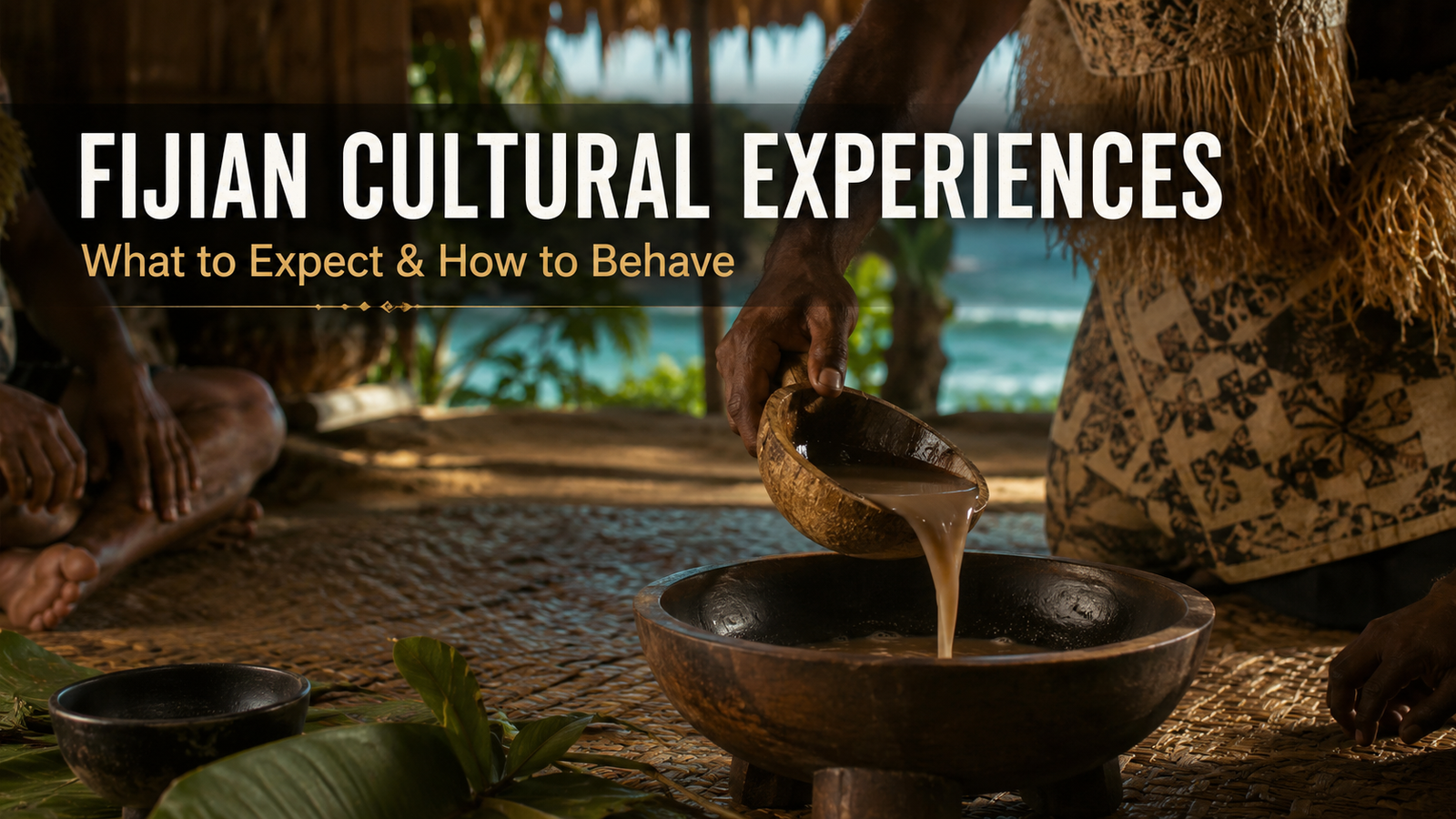
Sit in a semi-circle in a rough formation of sitting cross-legged on woven mats. The kava is pounded, mixed with water, strained, and handed out from a communal bowl in a bilo, a half coconut shell.
Your turn: Clap once, say bula, and drink the cup of water at once, then clap three times. The “claps” are cupped and hollow – you will know the difference! It’s earthy and slightly muddy; it will numb your lips and tongue for a few minutes. That’s normal.
You will be asked if you want “high tide” or “low tide” at times. That’s a full bi-lo or a small one, and it’s perfectly OK to ask for low tide.
The polite default is to take the first cup. If you do NOT want to drink, say vinaka and the bilo is passed to the next person. No one will point out to you.
Tape, tie, and fire walking
Lovo is an earth oven. Foods such as meat, fish, taro, and cassava root are wrapped in leaves and cooked for several hours in a covered pit over white-hot stones. In the past, the men were responsible for starting the fire and the women for preparing the food. Many resorts have a lovo night once a week, often accompanied by singing and dancing. The smoky taste is the reason: there’s no other way.
Meke (mixed dance, chant, and storytelling). It isn’t decoration. Meke, the art of carrying forward history, genealogies, and legend, was performed before the creation of written records, so the movements are precise, not improvised. Men’s dances are frequently spear or club dances, while women’s dances are more frequently with fans and sweeping, slower movements.
The term Firewalking, or vilavilairevo, means roughly jumping into the earth oven. Men walk on stones which are heated for several hours until they become extremely hot. The tradition is hereditary, reserved for particular family lines, and is unique to the Sawau people of Beqa Island. It will be present on Beqa and at the resorts on Coral Coast, where Beqa performers go to perform. If it is important to you, inquire about the performer — the real thing is by Beqa families, and asking guarantees they are credited properly.
Etiquette that really counts
- Cover shoulders & knees. A sulu (sarong) can be used by both men and women and is worn over top of any clothing.
- Take your hat and sunglasses off in the village. In Fijian culture, the head is a sacred place – don’t touch other people’s heads, even children’s.
- Take off your shoes when coming into a home or meeting house.
- Sit cross-legged on the mat. Women tend to tuck their legs to one side. Always avoid pointing your feet at people with your feet.
- When passing seated people, get down to their level and avoid looking up at the chief.
- Please request permission before taking photos of others. In the buildings and scenery, they are fine, but in the faces, they are a question.
- Get your host to seat you. It’s not something that can be seen from the outside that there’s an order to it.
- Skip Sundays. Most tours of the villages do not operate – it is a day for church and rest.
Frequently asked questions about Fijian cultural experiences
Do I have to drink kava?
No. Take the first bilo if you can do it comfortably, as it is a sign of acceptance, but no, not taking it is okay. Say vinaka, and it gets on with its work. When you are pregnant or taking medication, or if you are driving later, put down No without explanation – it’s not rude.
Is it safe to consume kava?
It doesn’t intoxicate you, it’s a little sleepy, and it’s a drink that’s been used in Fiji for centuries. May interact with alcohol and other medications; please seek advice from a health care professional before using it if you are taking a medication routinely.
What do I want to wear to a village?
Everyone’s shoulders and knees should be covered. Long skirts or dresses for girls, T-shirts and knee-length shorts for boys, and a sulu to cover them. Wear a bit more to the church or a formal sevusevu.
Are cultural shows in resorts real?
Yes, but it depends on the context. The groups are Fijian, often from nearby villages, and it is not a costume theatre, but rather paid cultural work. A resort stage can’t give you the context and the conversation a village visit can; but the concert version isn’t a fake one.
Is it okay for me to take pictures during a kava ceremony?
Ask a question and follow your host’s response. Some are playful, some are solemn and silent. Knowing what to do is even better than having a rule.
When do I NOT need to go to a village?
On Sundays, and at the time of a funeral or time of grief. Any good tour operator takes care of both, but it’s important to understand the differences in your Sunday schedule.
One item to bring with you?
It’s not the visitor’s responsibility to get everything right, and in Fijian culture, much is forgiven if the visitor is well-intentioned. People notice the effort- the sulu you brought, the hat you remembered to take off, asking. Well, that’s all.