The Top 7 Sweet and Savory Snacks in Fiji
Look, everyone shows you the pictures of Fiji’s perfect beaches. And yeah, they’re amazing. But no one tells you about the finest part: the stuff you eat when you’re not seated. I’m referring to the items you grab from a market booth because they smell too wonderful to pass up. The real travel memories? For me, they’re standing on a street corner in Suva, trying not to drip curry on my shoes from a warm roti parcel. That’s the good stuff.
Finding these snacks isn’t some complicated mission. It’s actually the easiest part of your day. Just keep your eyes open. The best food isn’t at the resort—it’s in the places where life is already happening. Follow the crowd to the local market. Pop inside a bakery that appears to have been unchanged since the 1980s. And, for goodness’ sake, pull over for that modest wooden stall by the side of the road with a few items heaped up. That is where you will find exactly what you’re looking for.
Snacks in Fiji have strong roots. The foundation is simple: take what the land provides—taro, cassava, coconut. Now bring in the spices, curries, and breads from Indian traditions. These styles are combined. They created a new category of local food. This is why the snacks here are unique. They are a direct mix of island and spice.
You will find this blend in every popular treat. Here are the essential ones to look for.
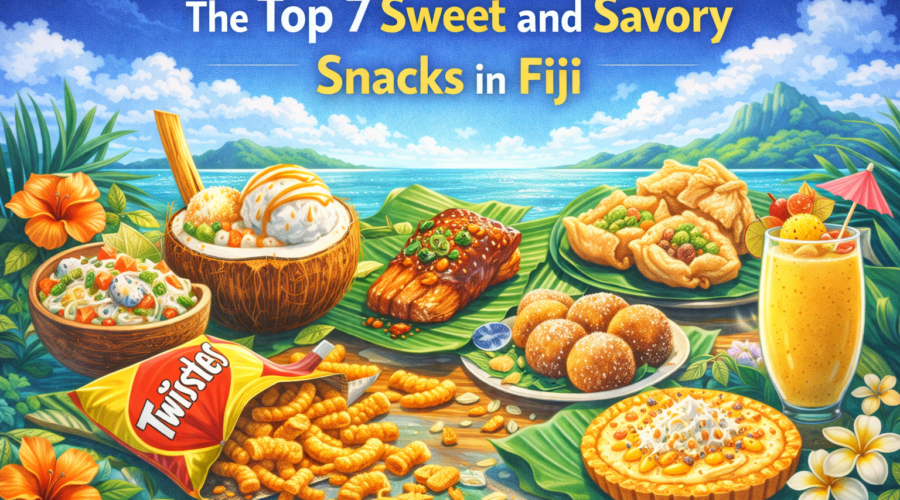
1. Cassava Chips
Forget the imported potato chips. The real snack is cassava chips. The chips are sliced thin and fried so they break with a sharp crackle. The flavor is uncomplicated—mostly just the root itself with a good hit of salt, which is what makes them so easy to eat. You buy them in a paper cone at the market. They don’t get soggy, even in the island heat. This is the crunch people actually eat here.
2. The Legendary Roti Parcel: A Flavor Hug
Oh, the roti parcel. The roti parcel is a common handheld meal. A warm, flat roti bread is wrapped around a serving of curry. Fillings commonly include dhal, spicy potato, or minced chicken. The vapor emitted when the parcel is opened smells like cumin and turmeric. The practical design contains the filling effectively for eating without utensils.
3. Vakalolo: A Sweet, Sticky Tradition
Vakalolo is often overlooked on the market since it appears to be nothing more than a basic bundle in a leaf. But it is the goal. It’s just boiling taro or cassava with coconut milk until the flavors combine to produce something entirely distinct. This dessert isn’t airy and light. It’s a hearty, sweet mouthful that lets the flavors of Fijian ingredients do the talking. A true star among the unique snacks in Fiji.
4. Babakau: Fiji’s Answer to the Doughnut
Calling all doughnut lovers! You have to meet Babakau. Babakau are simple fried dough rounds. The texture is their main feature—airy with a satisfying chew, and far less sweet than standard doughnuts. They’re typically enjoyed, torn apart by hand while still warm, and often dipped into a morning cup of tea. It’s a common, comforting start to the day here.
5. The Humble Bakery Pasty: A Savory Savior
A legacy from the British, the pasty has been totally adopted by Fiji and made its own. At any nearby bakery, look for the piles of golden-brown packages. When you bite into the flaky pastry, it breaks. There may be a basic but substantial stuffing of diced potatoes, seasoned chicken or fish, and a few peas. The combination’s capacity to offer a substantial, portable, and filling snack is responsible for its popularity as a fast lunch alternative.
6. Coconut Balls: Pure, Simple Joy
Sometimes you just need a little sweet bite. That’s where these come in. Just two things are needed to make mitii, or coconut balls: sugar and freshly shredded coconut. Small, sticky mounds are formed by hand rolling the material. Baking is unnecessary since the sugar and coconut oils bind naturally. They are a popular choice for a rapid energy boost due to their powerful sweetness and portability, especially during the warmer hours of the day.
7. Fried Taro: The Earthy Crisp
We started with a chip, let’s end with one. Compared to other root delicacies, fried taro has a distinct type of crunch. The chips have a delicate, almost lacy texture and fry extremely thin and crisp. With each bite, their distinct flavor—which is slightly earthy—is increasingly obvious. Their moderate flavor and gentle texture make them simple to consume in large numbers, according to many. A bag of these, a cold drink, and a sunset? Now that’s the good life.
What’s the big deal? Why do I go on about these Snacks in Fiji so much? Because they’re more than just food. They’re a connection. That roti parcel you bought from a smiling vendor, the Vakalolo shared at a village visit—these moments stick with you. Every taste seems like a true part of the culture, and the flavors are honest and fresh.
Want to find the real deal? Watch where the locals go. Early morning at the market is when you get the good stuff. See a crowd? That’s your signal. Don’t stress about the language – just point. It always works.
To be honest, you haven’t truly experienced Fiji unless you’ve eaten at a market stand. That’s where the true taste lies. Do not overthink it.
Just try something. The food and snacks in Fiji tell the story better than any tour guide ever could.
One last thing. Bring small bills. It makes buying from market stalls and roadside carts much easier. Also, carry a thermos of water with you—some of those spicy treats are best enjoyed with a cold drink.
That’s about all there is to it. Good snacks are everywhere in Fiji. You just have to be willing to stop and try them. Your stomach will figure out the rest.