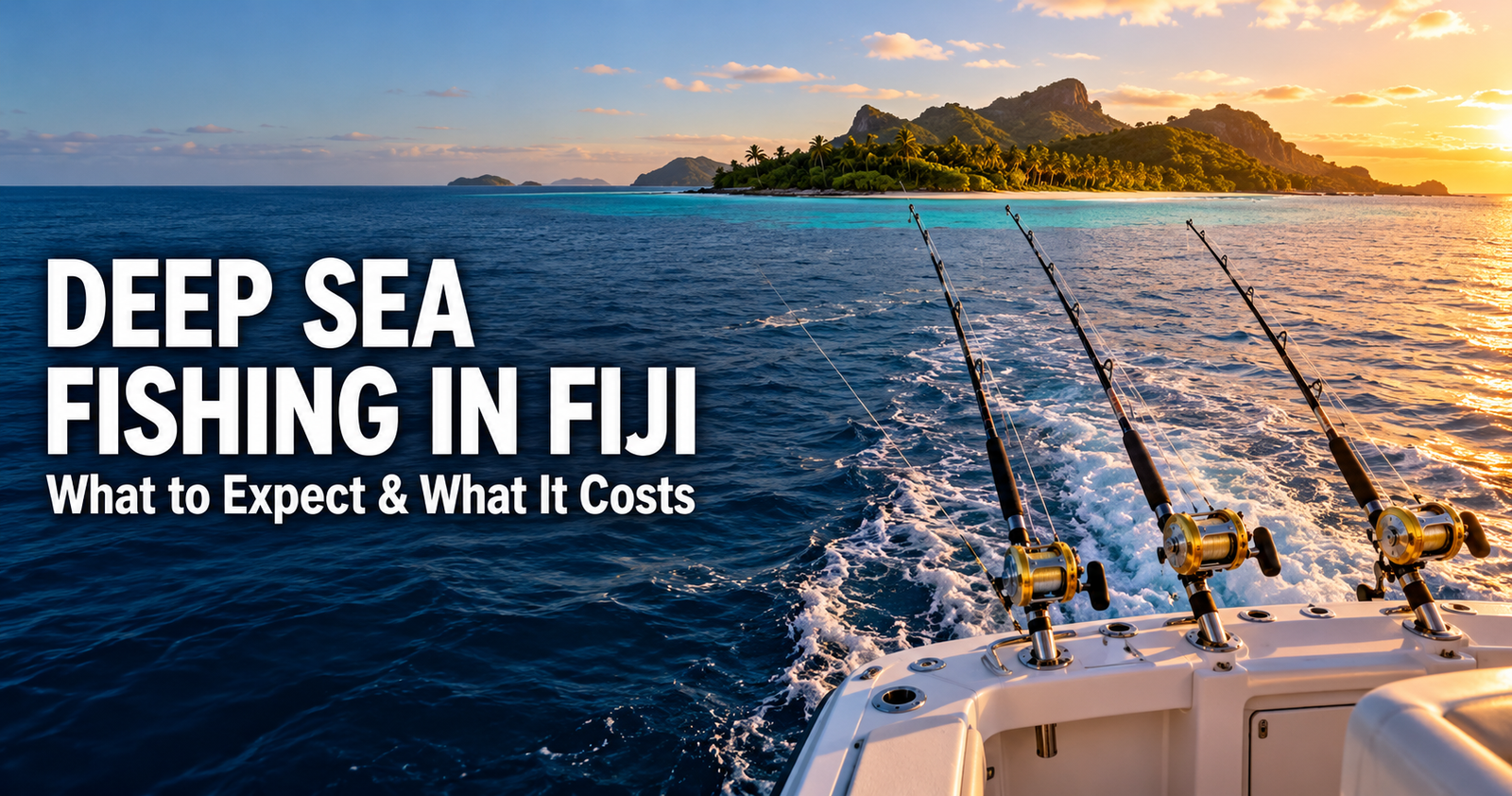
Fiji’s image is mostly beaches and resorts, but for the serious visitor, what’s under the water matters, and so does what’s willing to take an eight-mile lure. Deep-sea fishing charters in Fiji span the spectrum, from fun half-day trips to reef fishing to full-day pelagic trips for marlin and sailfish, and the range of options (and costs) is more varied than a first-timer might expect.
What does Deep Sea Really Mean Here?
Fishing in Fiji is split into two categories in general – and before booking, it’s important to understand the difference. Reef fishing will remain within the reefs, fishing for species such as giant trevally, snapper, and grouper around the reef structure. Deep-sea (“blue water”) fishing is beyond the reef into open ocean, trolling for pelagic species that do not linger around the structure, such as mahi-mahi, wahoo, yellowfin and dogtooth tuna, sailfish, and marlin. Most charters provide both, and a good operator will ask what you want, instead of assuming.
What to Expect on the Water
Charters operate for a half or full day. A half-day trip is 5-6 hours and is ideal for reef fishing or a shorter taste of trolling that is nearer to shore. If it is the deep-sea species you are after, then a full-day charter of about 8-9 hours is desired; the extra time is significant because it is getting to the best pelagic grounds and trolling effectively, not just a fast run out and back.
Most boats provide all fishing equipment, bait, ice, and a host of local knowledge and experience regarding where fish are running that week, and a captain or guide. Full-day charters usually provide a light lunch and drinks; half-day charters have a variety of options: some provide snacks and soft drinks, while others do not, and it’s the charterer’s responsibility to pack their own. Just don’t assume; this is one of the more common omissions between what a listing says and what’s actually offered.
No personal fishing license will be required. There are no individual recreational fishing licenses issued in Fiji; rather, each of the legal commercial charters is licensed and is your paying guest. That’s a reason to watch out for a bad operator, not a reason to be embarrassed.
Non-operator-dependent items that are useful: hat, sunglasses, reef-safe sunblock, comfortable non-slip shoes, and some light layer to spray on once the boat begins to move at speed. If you have ever experienced seasickness, you should consider taking medication BEFORE you go out; no one wants to be seasick in open ocean swells past the reef line, rather than in the lagoon waters.
What can you catch?
The waters of Fiji are very productive, and that’s one of the reasons why deep-sea fishing is a very popular scene here, not just a tourist attraction. Target species range from mahi-mahi, wahoo, and giant trevally to yellowfin and dogtooth tuna, sailfish, and marlin, as well as reef species like snapper, grouper, and barracuda (if present) in a season and area, as well as others that are available. Billfish are, in general, catch-and-release (C&R) on charters throughout Fiji, and in many cases, must be C&R, so don’t book a charter to keep a marlin for the wall.
A few key zones are where fishing grounds are concentrated; namely on the western side of the island of Viti Levu (Nadi and Denarau), Sigatoka and the Coral Coast, Savusavu on the island of Vanua Levu, and Bligh Water off the island of Volivoli, which is renowned for its giant trevally fishing. These are generally dependent on your accommodation as it will depend on which of these is most logistically feasible, as transfers to the point of departure may incur additional time and expense on certain charters.
What It Costs
The price range is quite substantial depending on the length of the trip, type of boat, and if it is shared or private. The shorter trips that focus mainly on reefs cost a lot less, while the full-day, private, deep-sea charters that focus on pelagic species, particularly those with a dedicated guide, resort transfers, and a higher-quality boat are much more expensive. Some operators have a shared pricing system (charging per person), others have a fixed rate for the boat, independent of the number of people (which is cheaper for a group of four or more).
The best way to get a feel for what a fair price is, is to get a quote straight from 2 or 3 operators in your area, just before committing to the boat. The items that tend to get you the lowest price but aren’t worth it are the gear, bait, lunch, drinks, and transfers.
Choosing a Charter
Some questions to consider before booking: How long has the operator been operating in this particular location? Is it a private booking (group only) or shared booking (for other groups)? What is covered in the package and what is an extra? For deep-sea fishing trips, how far from the beach does the boat normally venture, and will it be deep enough to catch what you are looking for? If you go for marlin, you don’t want a reef-fishing boat, and vice versa.
Once your fishing day is booked, browse more things to do in Fiji to fill out the rest of your trip.”
FAQs
What is the price of fishing in deep sea in Fiji?
Charter costs will depend on the length of the trip, type of boat, and private or group charter. A shorter reef trip will not be as expensive as a full-day pelagic trip. Please have a direct discussion with your operator about the price, as it varies seasonally and by boat.
What types of fish do you find in deep-sea fishing in Fiji?
Fishing species include mahi-mahi, wahoo, yellowfin and dogtooth tuna, sailfish, marlin, and giant trevally or other reef species near the coast. Billfish are mainly catch-and-release.
Do I need a fishing license to fish in Fiji?
There is no need for any sort of individual recreational license. Commercial charter operators have their own charter licences for on-board paying guests.
What is the difference between a half-day charter and full day charter?
A half-day is approximately 5-6 hours, and is suitable for reef fishing or shorter trips. If you’re looking to catch deep-sea fish, such as marlin or tuna, a full-day charter (usually 8-9 hours) will allow you to get to deeper pelagic waters.
In Fiji, is deep-sea fishing a good year-round activity?
Yes, fishing can be productive year-round in Fiji, with some species showing better runs in certain seasons, such as marlin and sailfish. A local operator can tell you what will be successful on your travel dates.
Where do most deep-sea fishing charters depart in Fiji from?
Common starting points are Nadi, Denarau, Sigatoka on the Coral Coast, Savusavu on Vanua Levu, and Volivoli in the north, where giant trevally fishing is popular in Bligh Water.
Read this article too: